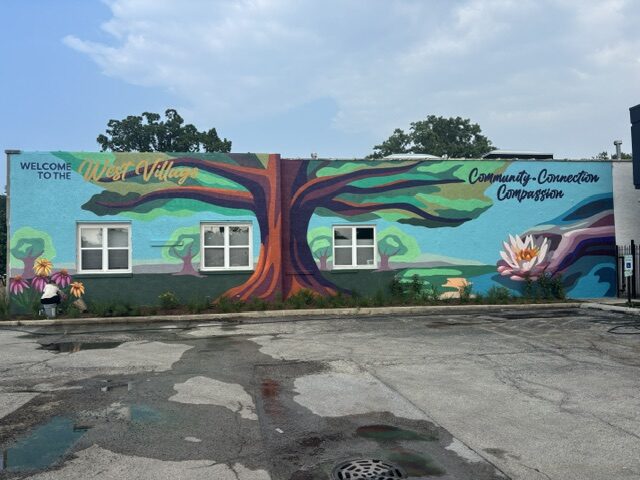
There is a reason Heartwood’s newest mural feels so fitting. At its center is a tree – rooted in place, growing outward, surrounded by life. Across the building are three words: Community. Connection. Compassion. For wellness practitioners, those words aren’t simply ideals. They can be part of the infrastructure that allows a practice – and the person behind it – to grow sustainably.
The overlooked side of building a practice
When we think about growing a wellness practice, we tend to think about the individual pieces: attracting clients, continuing education, scheduling, marketing, finances, refining our skills, and creating an experience that keeps people coming back. All of those things matter. But there is another part of sustainable practice-building that is easy to overlook: the environment surrounding the practitioner.
Wellness work can be surprisingly isolating. Many practitioners spend most of their working day one-on-one with clients. They may be responsible for their own schedules, business decisions, marketing, client relationships, professional development, and the countless small decisions involved in keeping a practice moving.
Even when the work itself is deeply relational, the business behind it can still feel like something we are building alone. Sustainability isn’t only about whether you can build something. It’s also about whether you have the conditions around you that allow you to keep building it.
Community changes the conditions
Community doesn’t remove the responsibility of running a practice, and it doesn’t build the practice for us. What it can do is change the conditions in which that work happens.
Connection reduces professional isolation. Having relationships with people who understand the realities of wellness work gives practitioners somewhere to exchange ideas, ask questions, talk through challenges, celebrate progress, and remember that they are not navigating every part of the work alone.
Collaboration expands what one practitioner can offer. A strong professional community creates opportunities for referrals, partnerships, cross-disciplinary learning, shared events, and connections between people whose work may complement one another.
Community creates continuity. When practitioners have places to return to – to learn, gather, reconnect, and participate – professional growth becomes less dependent on continually generating momentum alone.
Place matters, too. Community can be an idea, but physical spaces allow that idea to become an experience. A room where people can gather creates possibilities that simply don’t exist when everyone remains separate.
Healing can happen in community
Much of wellness work happens one-on-one: one practitioner, one client, one treatment room. That intimacy is one of the strengths of the work.
But healing and growth can also happen collectively. They can happen during a retreat. Around a table. In a workshop or support group. Through an organization gathering its people with intention. In a conversation between practitioners who discover that they have been wrestling with the same question. Or simply through the experience of being in a space where connection is encouraged rather than incidental.
This is part of what makes community spaces valuable. They give people somewhere to come together around learning, wellness, reflection, creativity, professional development, and shared experience.
Creating space for what comes next
Heartwood has been thinking a lot about what it means to create space for this kind of connection.
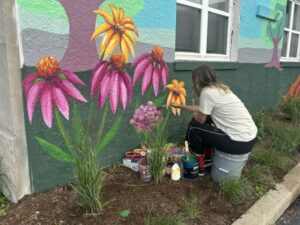
This summer, that intention became visible in a new way with the unveiling of our West Village mural, designed by a local artist and centered around those three words: Community. Connection. Compassion.
And this fall, that vision will take another step forward with the opening of Heartwood’s new community space – an event space designed with healing at its center. The space will welcome retreats, groups, organizations, practitioners, and others looking for a place to gather intentionally. It creates room not only for individual wellness, but for shared experiences that bring people together.
Because healing doesn’t only happen between a practitioner and a client. Sometimes it happens in the relationships, conversations, experiences, and communities that form around us.
Rooted enough to grow
The tree painted across Heartwood’s newest mural offers a fitting image for this next chapter.
A healthy tree doesn’t grow because its branches work harder. It grows because it has roots, resources, space, and an environment capable of supporting its expansion.
Our practices – and perhaps all of us – aren’t so different.
Sustainable growth isn’t always about finding one more strategy or doing more on our own. Sometimes it’s about strengthening the community around us.
And sometimes, the first step is simply creating a place where people can come together.