The recent kerfuffle about Heartwood’s tax exempt status initiated by a local political activist, apparently over his dismay that our Buddhist temple and holistic health care collective publicly challenged a fast food restaurant favored by elected officials he supports, has raised some questions in the community about whether or not Buddhism is even a religion.
It has been said that if you went to a convention of religious studies scholars and asked each one, “What is religion?,” you would get as many different answers as there were conferees in attendance. So we won’t pretend to try to define it here. But this blog post will point to a number of spiritual, cultural and legal hallmarks that seem common to all religions, in our effort to answer the question: “Is Buddhism a religion?”
For 3 to 5 million Americans, and somewhere between 324 to 535 million people worldwide, the short answer to that question is undoubtedly, “Yes.”
A slightly longer answer requires an acknowledgment that there is not a single Buddhism, but rather many different traditions that developed over two and half millennia as the teachings of Siddhartha Gautama (who lived and taught in what is now northern India some 500 or 600 years before the birth of Jesus Christ) spread across Asia and later globally. Today we have many Buddhisms — Theravāda, Zen, Ch’an, Nichiren, Tiantai, Huayan, Pure Land, Tibetan, and Insight to name but a few. Nonetheless, they all share the hallmarks of being a religion.
Spiritually, all forms of Buddhism posit a clear and distinct ultimate reality, just like all other religious traditions. Whether it’s called a pure land, or nirvana, or buddahood, or enlightenment, all schools and sects of Buddhism do have some notion of the ultimate. Just like all other forms of religion, all schools and sects of Buddhism provide a clear path to attaining that ultimate reality. Whether it’s the eightfold path of the Theravada tradition, the bodhisattva path of Mahayana, the creation and completion practices of Vajrayana, or something altogether different, Buddhist practitioners have a series of practices that culminate in the ultimate.
Culturally, like other religions, Buddhism has authoritative scriptures, doctrines and rich theological traditions. For example, the corpus of Tibetan Buddhist sacred texts alone is much more voluminous than the Bible, the Talmud and the Qur’an combined, and less than 10% of it has been translated into any Western language. Buddhist temples, monasteries, rituals, festivals, and clergy (monks, nuns, lamas) function in ways very similar to all other organized religions.
Like many other religions, most traditional Buddhist schools include cosmological and theological elements that require faith to affirm, such as multiple realms of existence, rebirth, bodhisattvas, protective deities, karma and so forth, well beyond secular philosophy. Finally, for hundreds of millions of people around the world, Buddhism provides their central religious identity and organizing principle — shaping birth, marriage and death rituals, and defining dimensions of a moral life — just like Christianity, Islam, Hinduism or Judaism does for others.
Legally, the U.S. Supreme Court recognized Buddhism as a nontheistic religion in Torcaso v. Watkins (1961). The U.S military provides Buddhist chaplains for service members. The U.S. Census Bureau includes Buddhism among the religions which participants may self-identify as practicing in its various surveys. The IRS grants tax-exempt religious organization status to Buddhist temples and associations, as it did for Heartwood in 2017, under the same rules and regulations it uses for all other churches, mosques, and synagogues. Legally and institutionally, Buddhism is fully recognized as a religion in the U.S.
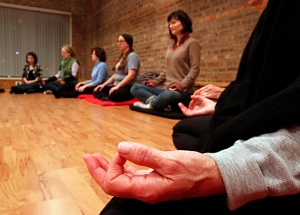
Heartwood’s meditation program was founded in 1999 under the guidance of His Holiness Penor Rinpoche, a contemporary of the Dalai Lama and considered by some his religious equal. That makes us among the longest-running, continuously active convert Buddhist centers in the Chicagoland area. Over the years, we have been blessed by an array of visiting teachers from a variety of Buddhist and other spiritual traditions. We also host an internationally recognized program for survivors of guru and teacher abuse.
At the time of our founding, Penor Rinpoche suggested we follow the model he and other Tibetan leaders had established for monasteries in India for the Tibetan community-in-exile by providing health care and housing in addition to religious and spiritual opportunities. Although it has taken longer than we had hoped when we moved to the neighborhood in 2010, we now make that vision a reality, providing free health care to many of our neighbors and to those who are surviving cancer, as well as six units of affordable housing for members of our community, in addition to all our religious and spiritual activities.
We asked our attorneys to look into the activist’s allegations about Heartwood’s legal status as a Buddhist temple. They found them completely baseless. You can read their analysis if you want. Or come discover it for yourself. We offer beginner-friendly classes every Sunday at 10am and every Tuesday at 5:30pm. (Our Friday class studies ancient texts, so it requires a bit of prior knowledge of Buddhism.) We hope to see you soon.